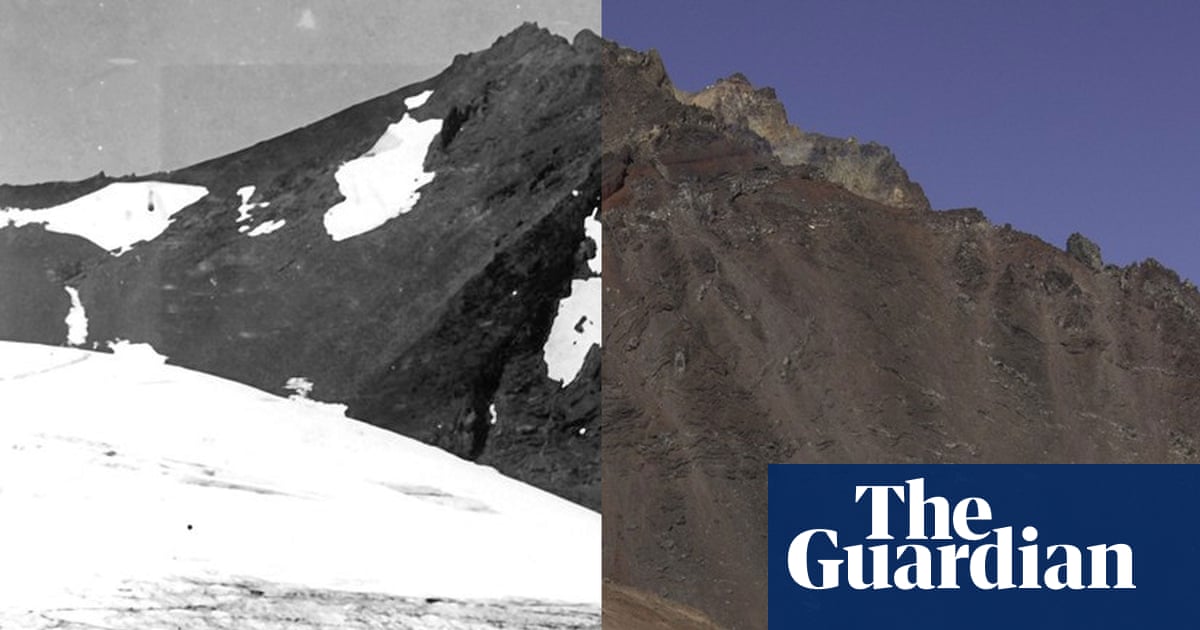
A new study has found that roughly 300 glaciers across the western United States have effectively vanished since the 1960s, and that most of those remaining are on course to shrink sharply as global temperatures continue to climb, The Guardian reports.
The research, published in the Proceedings of the National Academy of Sciences, used satellite imagery and aerial photographs to track how ice across six western states has receded over the past six decades. It found that the total glacier area in the region has contracted by about one-third since the 1960s, with signs that the pace of loss is increasing.
At the middle of the last century, the mountains of the American West held more than 1,450 glaciers, according to the study. These slow-moving bodies of ice, snow and rock fed streams and farmland as they gradually melted. Today, several hundred of them have shrunk to roughly the size of two football fields and no longer move — a state the researchers describe as functional disappearance.
Why it matters
Glaciers are small in number compared with the scale of the landscape, but they play an outsized role in alpine ecosystems and in the water supply of the western states. Their seasonal melt contributes to streams used for agriculture and to reservoirs that feed hydroelectric plants.
Their retreat also offers some of the most visible evidence of a shrinking snowpack, which is a major source of drinking water in the region. That makes the loss a concern for drought planning as well as for the wildlife and plants that depend on cold meltwater.
Andrew Fountain, a geographer at Portland State University who led the study, told The Guardian that the scale of the decline surprised him. He said he had wanted to produce the first proper inventory of the lower-48 glaciers, which he described as overlooked compared with the far larger ice fields of Alaska.
Smaller glaciers are going first
The study found that the fastest shrinkage has occurred among smaller glaciers that face south, and among those at lower elevations. In the Sierra Nevada, glaciers below about 9,000 feet have been hardest hit; in the Cascade range, which runs along the Pacific Northwest, the sharpest losses are below roughly 6,000 feet.
Even many of the larger glaciers are unlikely to last the century. Earlier work by Fountain has projected that within the next 50 years many will be gone, and that by 2100 the survivors may exist only in reduced form on the highest peaks in the West, such as Mount Hood and Mount Rainier.
Fountain attributed the decline to two pressures acting together. Warmer summers melt more ice, he told The Guardian, while winters increasingly bring rain rather than snow, which would otherwise replenish the glaciers. He said the outlook contains little to be hopeful about.
The study's authors also noted that the changes are visible to people who live near the mountains. Fountain said residents take pride in the glaciers and find bare slopes troubling.
A global pattern, and growing hazards
The decline is not limited to North America. The Guardian reports that scientists have documented similar retreats in Europe and the Himalayas as global heating has intensified, with consequences for crops and wildlife.
Fountain described the underlying mechanism simply: rising heat is melting ice nearly everywhere. He said cutting emissions could slow the losses, but that halting or restoring glaciers would take centuries, if it is possible at all.
There are also safety concerns. As ice and the rock it holds in place weaken, mountain terrain can become unstable. The Guardian cites the August collapse of glacier and bedrock along the Tibet–Nepal border, which killed at least 1,400 people, with thousands more still missing.
Eric Rignot, a glaciologist at the University of California, Irvine, told The Guardian that the danger is broader than the disappearance of ice itself: the ground left behind is no longer stable. He pointed to the Alps, where climbing seasons have grown shorter because conditions have become too risky.
Separately, melting at the polar ice sheets is driving up sea levels. A major study published last month found that about 12.5 trillion tons of ice has been lost from Greenland and Antarctica since 1979 — enough, The Guardian reports, to cover the continental United States to a depth of five feet. That melt has raised global sea levels by roughly an inch over four decades, worsening the effects of storms and flooding on coastlines.
For the western states, the practical question is how quickly the remaining glaciers will go. Watch for further inventories and modeling updates from researchers tracking the region's ice, and for how water managers factor the shrinking snowpack into drought planning.